Launch a Simulation Beamline#
This tutorial launches a complete simulation beamline on your workstation with
docker compose. It proves the container engine you set up in
Set up a Developer Workstation works, and gives you a running beamline to experiment
with before you build your own.
The example lives in the public
example-services
repository. One docker compose up brings up a self-contained set of
containers:
a simulated area-detector IOC (
bl01t-di-cam-01);a simulated motion IOC (
bl01t-mo-sim-01);a simple example IOC with a sum record (
bl01t-ea-test-01);a Channel Access gateway (
ca-gateway) and a PVA gateway (pvagw) that expose the IOCs’ PVs to the host;a Phoebus instance to view the beamline.
Note
You need docker compose (the v2 plugin, not podman-compose) plus a
container engine — Docker or podman. See Docker Compose Quickstart to install these on
any platform.
Launch it#
git clone https://github.com/epics-containers/example-services
cd example-services
source ./environment.sh        # set the EPICS ports and compose variables
docker compose up -d           # -d detaches; omit it to follow the combined logs
Note
The phoebus container draws its window on your host X display. If Phoebus does
not appear and its logs show X11 authorization errors — most likely on Wayland —
grant the local user access to the display and bring the stack back up:
xhost +SI:localuser:$(id -un)
Phoebus opens with an overview of the running beamline:
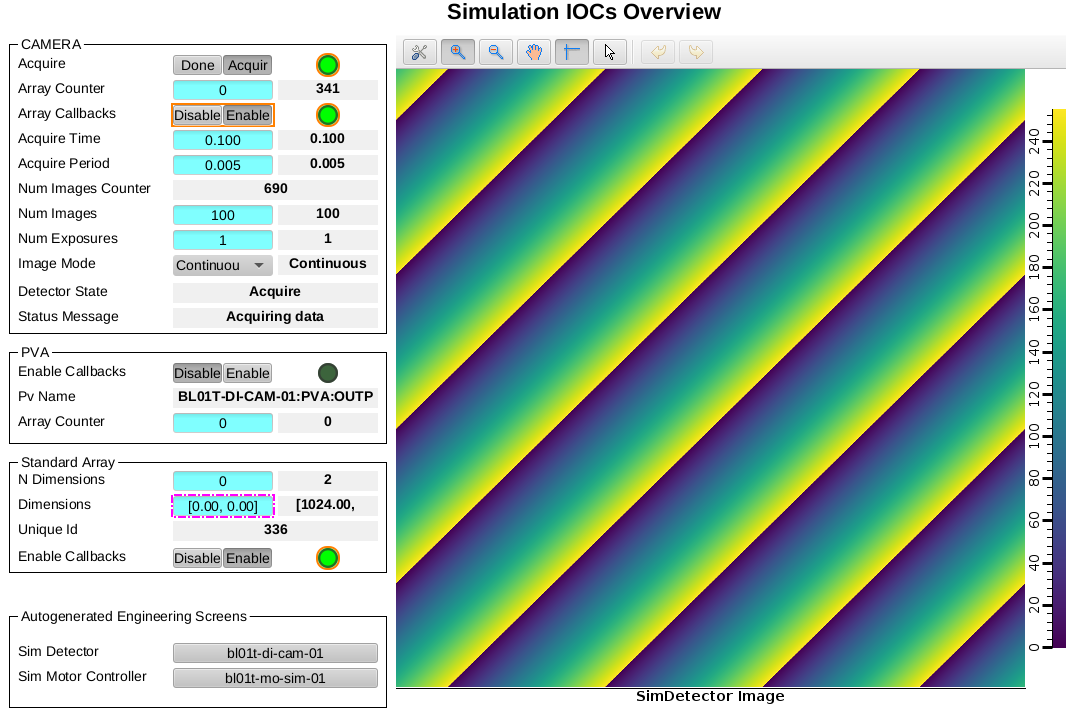
The example beamline overview screen.#
Talk to the beamline#
source ./environment.sh pointed your shell’s Channel Access at the gateway
(EPICS_CA_NAME_SERVERS=127.0.0.1:9064), so if you have the EPICS tools
installed locally you can read a PV straight away:
caget BL01T-DI-CAM-01:DET:Acquire_RBV
No local EPICS tools? Run caget inside one of the IOC containers instead:
docker compose exec bl01t-ea-test-01 caget BL01T-DI-CAM-01:DET:Acquire_RBV
Note
The gateway binds the Channel Access ports to 127.0.0.1 only, so these PVs are
reachable only from this host. That makes the example safe for tutorials —
nothing leaks onto the wider network.
Manage individual services with the usual compose subcommands (each takes a service name from the list above):
docker compose logs bl01t-di-cam-01 -f    # follow a service's logs (ctrl-c to exit)
docker compose stop bl01t-di-cam-01       # stop a service
docker compose start bl01t-di-cam-01      # start it again
Clean up#
Always tear the example down before moving on to the next tutorial. Volumes are kept, so IOC autosave data survives:
docker compose down
Important
If docker compose down times out removing the PVA gateway, just run it again —
the second pass clears the remaining container.